
-1.png?width=640&height=360&name=Coherent%20LinkedIn%20Image%20(2)-1.png)
.png?width=1200&height=1200&name=Untitled%20design%20(4).png)

There’s a familiar scene in every fast-growing insurance organization.
A sharp operator opens their laptop, takes a breath, and begins the daily scavenger hunt: policy admin in one tab, claims in another, a shared drive that looks like an archaeological dumpster fire, a Slack thread that may or may not contain the final decision, and a spreadsheet everyone insists is temporary.
If you asked that operator what they need, they might say, “one system.” They rarely mean it literally. They mean one place where the truth feels coherent.
Here’s the problem: “one place” is often two jobs.
This piece is a guide to separating them. It's not a taxonomy exercise. It is a way to prevent the most expensive form of operational waste in insurance, rebuilding yesterday from fragments.
Two systems, two duties
A system of record keeps score. It stores the facts you will eventually have to defend: the policy, the endorsement, the premium, the claim file, the payment, the audit trail. When regulators come calling, or a dispute turns into a deposition, it is the place you point to and say, “This is what happened.”
Insurance has always been a systems-of-record business. It has to be. The product is a promise, the proof is paperwork, and ambiguity is expensive.
A system of context does something subtler. It does not merely store what happened. It helps humans explain it.
Context software answers questions like:
-
What changed since last renewal?
-
Why did we make that underwriting exception?
-
Which version of that form was used, and who approved it?
-
What risk are we carrying right now, even if it is not showing up as a claim yet?
This is where workflow, narrative, and decision-making live. It’s where “what happened” becomes “what it means.” And increasingly, it's where competitive advantage shows up.
Why this matters now
Insurance platform buyers have an unromantic discovery sooner than most: many tools can store data, and many vendors can promise speed. Eventually, “faster” becomes table stakes.
Differentiation moves upward. The database stops being the story. The workflow becomes the story. The winning system is the one that makes decision-making feel obvious, not just possible.
In other words, the future often belongs to context.
Insurance is a context business disguised as a record business
In theory, insurance is clean: submit, quote, bind, collect premium, pay claims.
In reality, insurance operations are closer to literature than math.
There are characters (insureds, brokers, TPAs, counsel). There is plot (a loss, a timeline, a negotiation). There are footnotes (endorsements, exceptions, emails, attachments). There are alternate endings.
The difficulty is not just storing the data. It's explaining it. A modern organization does not just want to know that a claim was opened. It wants to know what changed, what triggered action, what was decided, and whether that decision can be defended later.
That is where context systems become practical, not philosophical.
Consider something as unglamorous as an activity feed: an inflexible timeline of actions, changes, and events. It is not a shiny “AI feature.” It's governance you can read and how teams avoid rebuilding the past from fragments.
Or put differently: context is not a vibe. Context is a mechanism.
The AI temptation: context theater
At this point, it’s hard to write about systems of context without bumping into AI. AI makes context tempting because it can summarize, classify, extract, and recommend. It can turn the haystack into a neat pile.
But there is a trap here: context theater.
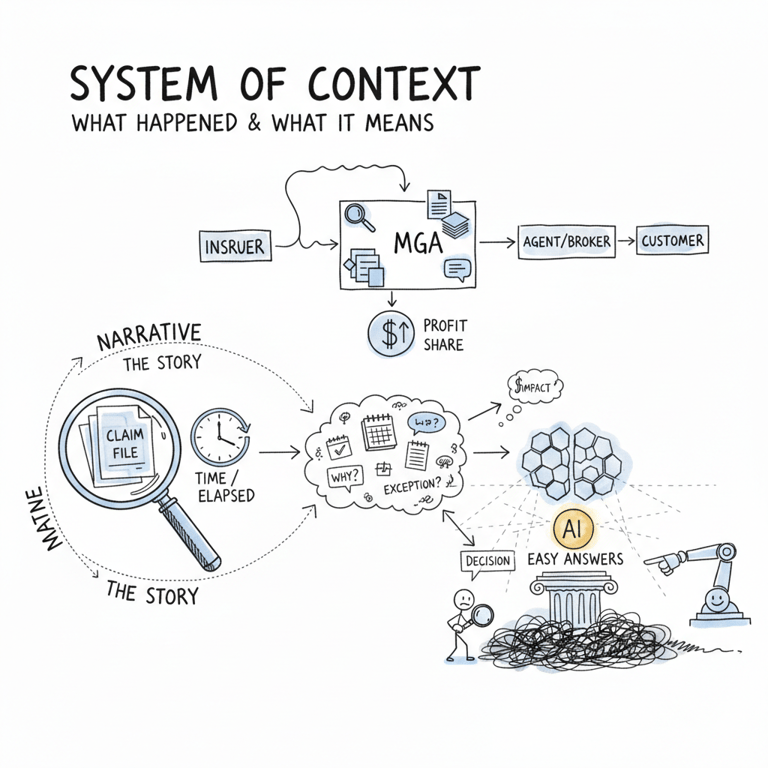
Context theater looks like:
-
a chat window that can “answer questions,” but cannot cite the underlying record,
-
a dashboard that looks authoritative, but cannot explain its inputs,
-
an automation that “handles the workflow,” until an exception appears and everything turns into email again.
The reason it fails is simple: insurance does not reward cleverness. It rewards defensibility. If a system cannot show its work, it cannot be trusted at scale.
The most useful applications of AI in insurance tend to be the boring ones: extraction, reconciliation, validation, and consistency checks. Not because the industry lacks imagination, but because the industry has consequences.
Take invoice review. If you can reliably extract line items, evaluate them against explicit payment rules, and flag discrepancies, you have taken a real cost center and made it auditable and repeatable. Not flashy. Extremely valuable.
Where MGAs feel this first
MGAs tend to encounter these issues early because they live close to growth pressure. When volume rises, complexity does not rise politely. It shows up as delayed issuance, messy renewals, misrouted tasks, and tribal knowledge that becomes an operational liability.
This is the environment where “system of context” becomes more than a slogan.
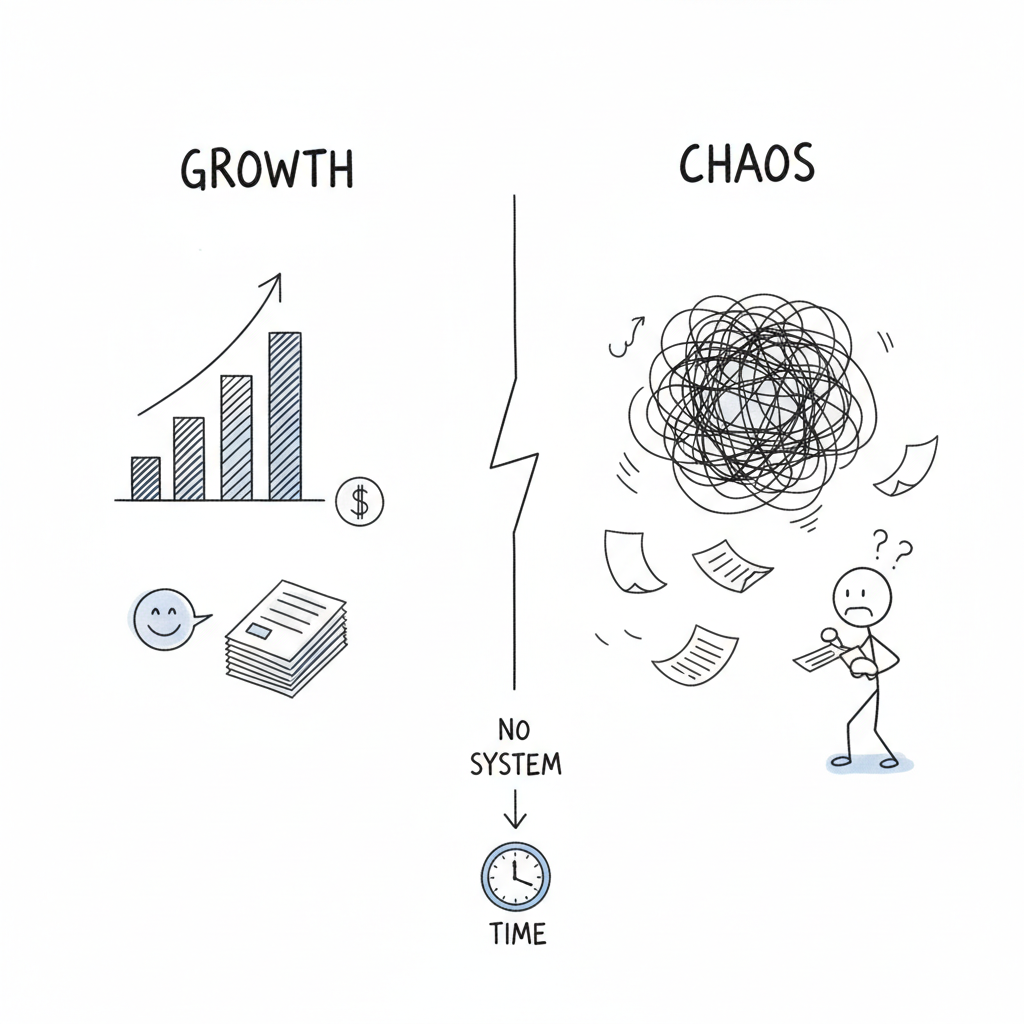
Because in MGA life, context is the difference between:
-
“We can grow” and “We are growing into chaos.”
-
“We have controls” and “We have people who remember things.”
-
“We can explain this” and “Give us a day to reconstruct the file.”
A practical way to think about the split
If you are building or buying in this category, here is the simplest mental model.
Systems of record should be: authoritative, structured, durable, and boring in the best sense.
Systems of context should be: workflow-native, explainable, inspection-friendly, designed for exceptions and not just happy paths.
The common mistake is trying to get one system to behave like both, without acknowledging the trade-offs.
A record system that tries to become pure context can turn into a cluttered command center: endlessly configurable, never fully adopted.
A context layer that tries to pretend it is the record becomes a shadow system. Shadow systems always end the same way: with reconciliation.
The better approach is to decide where truth lives, then build context around it that is measurable, reviewable, and tied to real workflows.
The real advantage: coherence
A decade ago, software bragged about speed. Today, everyone claims speed.
The new brag is coherence.
Coherence looks like fewer handoffs, fewer private spreadsheets, fewer “final-final” attachments, and fewer mysteries that require a meeting to decode.
It also means something that does not show up in demos: the organization can keep functioning when the smartest people are unavailable. The knowledge is inside the workflow, not inside a person.
In insurance, that is not a cultural preference. It is risk management.
The next few years will reward the unromantic
Here is a prediction that should age decently: the platforms that win in insurance will be the ones that make work inspectable.
Not just automated. Inspectable.
Not just summarized. Defensible.
Not just intelligent. Governed.
Systems of record will remain necessary, and in many cases, non-negotiable. But differentiation will move to context: how decisions are made visible, how exceptions are handled, how operational truth is assembled, and whether the business can produce a clean narrative on demand.
Insurance is, at heart, a story about promises and proof.
The future belongs to the systems that can keep both straight.
To book a demo with us, please click here.
.png?width=1120&height=630&name=Coherent%20LinkedIn%20Image%20(1).png)